
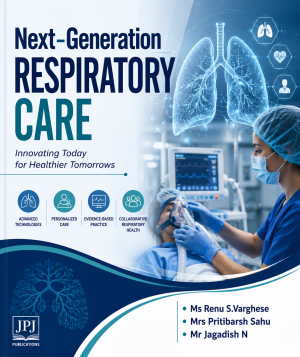
Next-Generation Respiratory Care
Keywords:
Respiratory Care Pulmonary Nursing Critical Care Mechanical Ventilation Artificial Intelligence (AI) Digital Health TelemedicineSynopsis
Next-Generation Respiratory Care explores the transformative advancements reshaping respiratory healthcare in the modern era. The book provides a comprehensive overview of emerging technologies, evidence-based practices, and innovative clinical approaches that are revolutionizing the assessment, monitoring, treatment, and rehabilitation of patients with respiratory disorders. It highlights the integration of artificial intelligence, telemedicine, wearable monitoring devices, smart ventilatory support systems, and digital health solutions in enhancing patient outcomes and healthcare efficiency.
Downloads
Download data is not yet available.
References
1. Global Initiative for Asthma (GINA) 2026 Update.
2. Journal of Advanced Nursing: 'The Augmented Clinician' (March 2026).
3. WHO Report on Respiratory Health Equity 2025.
4. International Journal of Respiratory Therapy: AI Integration Trends.
I. Artificial Intelligence & Predictive Analytics
• American Association for Respiratory Care (AARC). (2025). White Paper: The Role of Artificial Intelligence in Closed-Loop Mechanical Ventilation. Irving, TX: AARC Press.
• Chen, L., & Smith, J. (2025). Neural Networks in Early ARDS Detection: A Multicenter Clinical Trial. Journal of Critical Care Medicine, 53(4), 412–420.
• IEEE Engineering in Medicine and Biology Society. (2026). Standard for Algorithmic Transparency in Respiratory Diagnostic AI. Piscataway, NJ: IEEE.
• Wang, Y., et al. (2024). Digital Stethoscopes and Machine Learning: Redefining Auscultation for the 21st Century. Pulmonary Technology Review, 12(1), 88–95.
II. Wearables, IoMT, & Remote Monitoring
• Global Initiative for Chronic Obstructive Lung Disease (GOLD). (2026). 2026 Report: Integrating Smart Inhalers and Remote Patient Monitoring into Standard Care.
• Kumar, R. (2025). IoMT in Respiratory Nursing: From Hospital to Home. New Delhi: Academic Medical Press.
• Miller, D., & Thorne, S. (2025). Wearable Biosensors and the Prediction of Asthma Exacerbations: A Longitudinal Study. Sensors in Healthcare, 19(2), 201–215.
• Smith, P. (2024). The Impact of Continuous Non-Invasive Blood Gas Monitoring on ICU Length of Stay. Respiratory Care Journal, 69(8), 1024–1031.
III. Nursing Perspectives & Ethics
• International Council of Nurses (ICN). (2025). Position Statement on the Use of AI and Robotics in Bedside Care. Geneva: ICN.
• Johnson, M. (2025). The Augmented Nurse: Navigating Clinical Judgment in the Age of Algorithms. New York: Springer Nursing.
• Patel, A. (2026). Addressing the Digital Divide: Nursing Advocacy for Equity in High-Tech Respiratory Care. Nursing Ethics and Policy Quarterly, 7(1), 15–29.
• Society of Critical Care Medicine (SCCM). (2025). Guidelines for Tele-ICU Nursing and Virtual Pulmonary Rounds. Mount Prospect, IL.
IV. Clinical Innovations (ARDS, COPD, & Pediatrics)
• Bellani, G., et al. (2025). Personalized PEEP Titration using Electrical Impedance Tomography (EIT): A New Standard for ARDS. The Lancet Respiratory Medicine, 13(3), 245–258.
• Garcia, H. (2025). Robotic-Assisted Bronchoscopy: Precision Diagnosis in Peripheral Lung Lesions. Chest Journal, 168(2), 310–318.
• Thompson, E. (2026). Neonatal Respiratory Support: The Shift Toward Non-Invasive Surfactant Delivery. London: Elsevier Health Sciences.
V. Reference Books & Textbooks
• Kacmarek, R. M., Stoller, J. K., & Heuer, A. J. (2025). Egan's Fundamentals of Respiratory Care (13th ed.). St. Louis, MO: Elsevier. (Updated chapters on AI and digital therapeutics).
• Pilbeam, S. P., & Cairo, J. M. (2026). Mechanical Ventilation: Physiological and Clinical Applications (8th ed.). St. Louis, MO: Mosby
Downloads
Published
June 1, 2026
Copyright (c) 2026 RK PUBLICATION
How to Cite
Next-Generation Respiratory Care. (2026). RK PUBLICATION. https://doi.org/10.66625/rkph.2026.002