
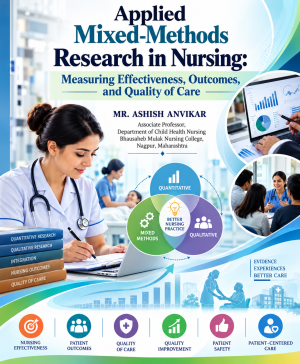
Applied Mixed-Methods Research in Nursing: Measuring Effectiveness, Outcomes, and Quality of Care
Keywords:
Mixed-Methods Research; Nursing Research; Quantitative Research; Qualitative Research; Research Design; Nursing Interventions; Nursing Effectiveness; Patient Outcomes; Nursing-Sensitive Outcomes; Quality of Nursing Care; Patient Safety; Quality Improvement; Evidence-Based Nursing Practice; Patient-Centered Care; Data Integration; Triangulation; Joint Displays; Outcome Measurement; Clinical Indicators; Research Validity; Reliability; Trustworthiness; Nursing Practice; Healthcare Quality; Nursing Education; Healthcare Research.Synopsis
Abstract
Mixed-methods research provides a comprehensive approach to investigating complex issues in nursing by combining the strengths of quantitative and qualitative research methods. Quantitative approaches provide measurable evidence regarding effectiveness, clinical outcomes, patient safety, and quality of care, whereas qualitative approaches provide deeper understanding of patients’ experiences, perceptions, beliefs, behaviors, and the contextual factors influencing healthcare delivery. This chapter, “Applied Mixed-Methods Research in Nursing: Measuring Effectiveness, Outcomes, and Quality of Care,” presents the principles and practical application of mixed-methods research in nursing and healthcare settings. It discusses major mixed-methods designs, including convergent parallel, explanatory sequential, exploratory sequential, embedded, multiphase, and transformative designs. The chapter further explains the planning of mixed-methods nursing studies, sampling strategies, ethical considerations, integration of quantitative and qualitative findings, and approaches to data analysis and interpretation. Particular attention is given to measuring nursing effectiveness, patient and nursing outcomes, quality of nursing care, patient safety, patient satisfaction, quality of life, and nursing-sensitive outcomes. The chapter also describes the application of mixed methods in evaluating nursing interventions and quality-improvement initiatives, including the use of clinical indicators, patient-reported outcome measures, and the Plan–Do–Study–Act approach. Issues related to validity, reliability, credibility, dependability, confirmability, transferability, and mixed-methods rigor are discussed. Practical applications across medical-surgical, child health, mental health, community health, maternal and newborn nursing, nursing education, and administration are highlighted. The chapter concludes by examining emerging opportunities involving digital health technologies, electronic health records, artificial intelligence, patient-generated health data, big-data integration, and multidisciplinary research. Overall, mixed-methods research offers nursing researchers a powerful framework for generating comprehensive, clinically relevant, patient-centered, and evidence-based knowledge that can contribute to improved healthcare outcomes and quality of nursing practice.
Downloads
Download data is not yet available.
References
1. Creswell, J. W., & Plano Clark, V. L. (2025). Designing and conducting mixed methods research (4th ed.). SAGE Publications.
2. Creswell, J. W., & Creswell, J. D. (2018). Research design: Qualitative, quantitative, and mixed methods approaches (5th ed.). SAGE Publications.
3. Johnson, R. B., & Onwuegbuzie, A. J. (2004). Mixed methods research: A research paradigm whose time has come. Educational Researcher, 33(7), 14–26. https://doi.org/10.3102/0013189X033007014
4. Johnson, R. B., Onwuegbuzie, A. J., & Turner, L. A. (2007). Toward a definition of mixed methods research. Journal of Mixed Methods Research, 1(2), 112–133. https://doi.org/10.1177/1558689806298224
5. Tashakkori, A., & Teddlie, C. (Eds.). (2010). SAGE handbook of mixed methods in social & behavioral research (2nd ed.). SAGE Publications.
6. O’Cathain, A., Murphy, E., & Nicholl, J. (2010). Three techniques for integrating data in mixed methods studies. BMJ, 341, c4587. https://doi.org/10.1136/bmj.c4587
7. Leech, N. L., & Onwuegbuzie, A. J. (2009). A typology of mixed methods research designs. Quality & Quantity, 43, 265–275. https://doi.org/10.1007/s11135-007-9105-3
8. Collins, K. M. T., Onwuegbuzie, A. J., & Jiao, Q. G. (2007). A mixed methods investigation of mixed methods sampling designs in social and health science research. Journal of Mixed Methods Research, 1(3), 267–294. https://doi.org/10.1177/1558689807299526
9. Creamer, E. G. (2018). An introduction to fully integrated mixed methods research. SAGE Publications.
10. Plano Clark, V. L., Anderson, N., Wertz, J. A., Zhou, Y., Schumacher, K., & Miaskowski, C. (2015). Conceptualizing longitudinal mixed methods designs: A methodological review of health sciences research. Journal of Mixed Methods Research, 9(4), 297–319. https://doi.org/10.1177/1558689814543563
11. Strudsholm, T., Meadows, L. M., Vollman, A. R., Thurston, W. E., & Henderson, R. (2016). Using mixed methods to facilitate complex, multiphased health research. International Journal of Qualitative Methods, 15, 1–11. https://doi.org/10.1177/1609406915624579
12. Fetters, M. D., Curry, L. A., & Creswell, J. W. (2013). Achieving integration in mixed methods designs—Principles and practices. Health Services Research, 48(6, Pt. 2), 2134–2156. https://doi.org/10.1111/1475-6773.12117
13. Harrison, R. L., Reilly, T. M., & Creswell, J. W. (2020). Methodological rigor in mixed methods: An application in management studies. Journal of Mixed Methods Research, 14(4), 473–495. https://doi.org/10.1177/1558689819858057
14. Levitt, H. M., Bamberg, M., Creswell, J. W., Frost, D. M., Josselson, R., & Suárez-Orozco, C. (2018). Journal article reporting standards for qualitative primary, qualitative meta-analytic, and mixed methods research in psychology: The APA Publications and Communications Board task force report. American Psychologist, 73(1), 26–46. https://doi.org/10.1037/amp0000151
15. Polit, D. F., & Beck, C. T. (2021). Nursing research: Generating and assessing evidence for nursing practice (11th ed.). Wolters Kluwer.
16. LoBiondo-Wood, G., & Haber, J. (2022). Nursing research: Methods and critical appraisal for evidence-based practice (10th ed.). Elsevier.
17. Grove, S. K., Gray, J. R., & Burns, N. (2015). Understanding nursing research: Building an evidence-based practice (6th ed.). Elsevier.
18. Lincoln, Y. S., & Guba, E. G. (1985). Naturalistic inquiry. SAGE Publications.
19. Braun, V., & Clarke, V. (2022). Thematic analysis: A practical guide. SAGE Publications.
20. Donabedian, A. (1988). The quality of care: How can it be assessed? JAMA, 260(12), 1743–1748. https://doi.org/10.1001/jama.260.12.1743
Downloads
Published
October 5, 2026
Copyright (c) 2026 RK PUBLICATION
Details about this monograph
ISBN-13 (15)
978-81-181100-7-1
How to Cite
Applied Mixed-Methods Research in Nursing: Measuring Effectiveness, Outcomes, and Quality of Care . (2026). RK PUBLICATION. https://doi.org/10.66625/rkph.2026.0025