
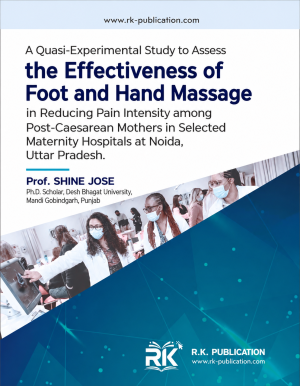
A Quasi-Experimental Study to Assess the Effectiveness of Foot and Hand Massage in Reducing Pain Intensity among Post-Caesarean Mothers in Selected Maternity Hospitals at Noida, Uttar Pradesh.
Keywords:
Quasi-experimental study, Foot massage, Hand massage, Pain intensity, Post-caesarean mothers, Caesarean section, Postoperative pain, Non-pharmacological pain management, Maternity hospital, Maternal health, Noida, Uttar Pradesh.Synopsis
ABSTRACT: Caesarean section is a commonly performed surgical procedure, and postoperative pain is a major concern that can affect maternal comfort, mobility, breastfeeding, sleep, and overall recovery. The present quasi-experimental study was conducted to assess the effectiveness of foot and hand massage in reducing pain intensity among post-caesarean mothers in a selected maternity hospital at Noida, Uttar Pradesh. A pre-test assessment of pain intensity was conducted among eligible post-caesarean mothers using a standardized pain assessment scale. The experimental group received foot and hand massage as a non-pharmacological intervention for a specified duration, while the control group received routine postoperative care. Following the intervention, a post-test assessment was carried out to determine changes in pain intensity. The findings indicated a reduction in pain intensity among mothers who received foot and hand massage, suggesting that the intervention may be an effective, simple, safe, non-invasive, and cost-effective supportive nursing measure for postoperative pain management and improvement of maternal comfort after caesarean section.
Downloads
Download data is not yet available.
References
1. American College of Obstetricians and Gynecologists. (2024). Optimizing postpartum care. https://www.acog.org/clinical/clinical-guidance/committee-opinion/articles/2018/05/optimizing-postpartum-care
2. Apfelbaum, J. L., Chen, C., Mehta, S. S., & Gan, T. J. (2003). Postoperative pain experience: Results from a national survey suggest postoperative pain continues to be undermanaged. Anesthesia & Analgesia, 97(2), 534–540.
3. Chou, R., Gordon, D. B., de Leon-Casasola, O. A., Rosenberg, J. M., Bickler, S., Brennan, T., Carter, T., Cassidy, C. L., Chittenden, E. H., Degenhardt, E., Griffith, S., Manworren, R., McCarberg, B., Montgomery, R., Murphy, J., Perkal, M. F., Suresh, S., Sluka, K., Strassels, S., & Wu, C. L. (2016). Management of postoperative pain: A clinical practice guideline from the American Pain Society, the American Society of Regional Anesthesia and Pain Medicine, and the American Society of Anesthesiologists. The Journal of Pain, 17(2), 131–157. https://doi.org/10.1016/j.jpain.2015.12.008
4. Deussen, A. R., Ashwood, P., Martis, R., Stewart, F., & Grzeskowiak, L. E. (2023). Relief of pain due to uterine cramping/involution after birth. Cochrane Database of Systematic Reviews.
5. Hodnett, E. D., Gates, S., Hofmeyr, G. J., & Sakala, C. (2013). Continuous support for women during childbirth. Cochrane Database of Systematic Reviews, (7), CD003766. https://doi.org/10.1002/14651858.CD003766.pub5
6. International Association for the Study of Pain. (2020). IASP announces revised definition of pain. https://www.iasp-pain.org
7. Kwekkeboom, K. L., & Gretarsdottir, E. (2006). Systematic review of relaxation interventions for pain. Journal of Nursing Scholarship, 38(3), 269–277. https://doi.org/10.1111/j.1547-5069.2006.00113.x
8. McCaffery, M., & Pasero, C. (1999). Pain: Clinical manual (2nd ed.). Mosby.
9. Melzack, R., & Wall, P. D. (1965). Pain mechanisms: A new theory. Science, 150(3699), 971–979. https://doi.org/10.1126/science.150.3699.971
10. Moyer, C. A., Rounds, J., & Hannum, J. W. (2004). A meta-analysis of massage therapy research. Psychological Bulletin, 130(1), 3–18. https://doi.org/10.1037/0033-2909.130.1.3
11. National Institute for Health and Care Excellence. (2021). Caesarean birth (NICE Guideline NG192). NICE. https://www.nice.org.uk/guidance/ng192
12. Pasero, C., & McCaffery, M. (2011). Pain assessment and pharmacologic management. Mosby/Elsevier.
13. Practice Guidelines for Obstetric Anesthesia: An Updated Report by the American Society of Anesthesiologists Task Force on Obstetric Anesthesia and the Society for Obstetric Anesthesia and Perinatology. (2016). Anesthesiology, 124(2), 270–300. https://doi.org/10.1097/ALN.0000000000000935
14. Smith, C. A., Levett, K. M., Collins, C. T., Dahlen, H. G., Ee, C. C., & Suganuma, M. (2018). Massage, reflexology and other manual methods for pain management in labour. Cochrane Database of Systematic Reviews, (3), CD009290. https://doi.org/10.1002/14651858.CD009290.pub3
15. Stevens, B. J., Abbott, L. K., Yamada, J., Harrison, D., Stinson, J., Taddio, A., Barwick, M., Latimer, M., Scott, S. D., Rashotte, J., Campbell-Yeo, M., & CIHR Team in Children's Pain. (2011). Epidemiology and management of painful procedures in children in Canadian hospitals. Canadian Medical Association Journal, 183(7), E403–E410. https://doi.org/10.1503/cmaj.101341
16. World Health Organization. (2022). WHO recommendations for care of the preterm or low-birth-weight infant. World Health Organization.
17. World Health Organization. (2022). WHO recommendations on maternal and newborn care for a positive postnatal experience. World Health Organization. https://www.who.int/publications/i/item/9789240045989
Downloads
Published
September 23, 2026
Copyright (c) 2026 RK PUBLICATION
Details about this monograph
ISBN-13 (15)
978-81-181100-3-3
How to Cite
A Quasi-Experimental Study to Assess the Effectiveness of Foot and Hand Massage in Reducing Pain Intensity among Post-Caesarean Mothers in Selected Maternity Hospitals at Noida, Uttar Pradesh. (2026). RK PUBLICATION. https://doi.org/10.66625/rkph.2026.0024