
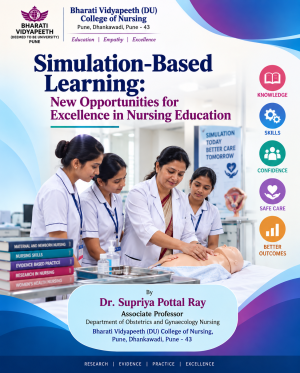
Simulation-Based Learning: New Opportunities for Excellence in Nursing Education
Keywords:
Simulation-Based Learning, Nursing Education, Clinical Simulation, Nursing Students, Simulation Technology, Skills Training, Experiential Learning, Patient Safety, Clinical Competence, Evidence-Based Practice, Healthcare Education, Virtual Simulation, High-Fidelity Simulation, Nursing Skills, Innovative Teaching, Competency-Based Education, Clinical Decision-Making, Student Engagement, Nursing PracticeSynopsis
Simulation-based learning provides nursing students with safe, realistic clinical experiences. It improves clinical skills, confidence, critical thinking, decision-making, and patient safety. Through simulation, students can practice and learn from mistakes without risking patient harm. Thus, simulation-based learning is a valuable approach for achieving excellence in nursing education.
Downloads
Download data is not yet available.
References
Reference
1. Cant, R. P., & Cooper, S. J. (2010). Simulation-based learning in nurse education: Systematic review. Journal of Advanced Nursing, 66(1), 3–15. https://doi.org/10.1111/j.1365-2648.2009.05240.x
2. Cant, R. P., & Cooper, S. J. (2017). Use of simulation-based learning in undergraduate nurse education: An umbrella systematic review. Nurse Education Today, 49, 63–71. https://doi.org/10.1016/j.nedt.2016.11.015
3. Cant, R. P., & Cooper, S. J. (2017). The value of simulation-based learning in pre-licensure nurse education: A state-of-the-art review and meta-analysis. Nurse Education in Practice, 27, 45–52. https://doi.org/10.1016/j.nepr.2017.08.012
4. INACSL Standards Committee. (2021). Healthcare Simulation Standards of Best Practice™: Outcomes and objectives. Clinical Simulation in Nursing, 58, 40–44. https://doi.org/10.1016/j.ecns.2021.08.013
5. Sittner, B. J., Aebersold, M. L., Paige, J. B., Graham, L. L. M., Schram, A. P., Decker, S. I., & Lioce, L. (2015). INACSL Standards of Best Practice: Simulation: Past, present, and future. Nursing Education Perspectives, 36(5), 294–298. https://doi.org/10.5480/15-1670
6. Kim, J., Park, J. H., & Shin, S. (2016). Effectiveness of simulation-based nursing education depending on fidelity: A meta-analysis. BMC Medical Education, 16, Article 152. https://doi.org/10.1186/s12909-016-0672-7
7. Foronda, C., Liu, S., & Bauman, E. B. (2013). Evaluation of simulation in undergraduate nurse education: An integrative review. Clinical Simulation in Nursing, 9(10), e409–e416. https://doi.org/10.1016/j.ecns.2012.11.003
8. Shin, S., Park, J. H., & Kim, J. H. (2015). Effectiveness of patient simulation in nursing education: Meta-analysis. Nurse Education Today, 35(1), 176–182. https://doi.org/10.1016/j.nedt.2014.09.009
9. Shah, S., Khan, A. A., Al Meqbaali, M., Syed, R., & Al Sinani, M. (2026). Simulation-based education versus traditional teaching for nursing students: A systematic review. Health Science Reports, 9(7), e72731. https://doi.org/10.1002/hsr2.72731
10. Kim, H. J., Lee, E. K., & Mun, E. J. (2026). Effectiveness of scenario-based simulation in adult nursing education: A systematic review and meta-analysis. Nurse Education in Practice, 95, 104929. https://doi.org/10.1016/j.nepr.2026.104929
Downloads
Published
September 11, 2026
Copyright (c) 2026 RK PUBLICATION
Details about this monograph
ISBN-13 (15)
978-81-180067-5-6
How to Cite
Simulation-Based Learning: New Opportunities for Excellence in Nursing Education . (2026). RK PUBLICATION. https://doi.org/10.66625/rkph.2026.0022