
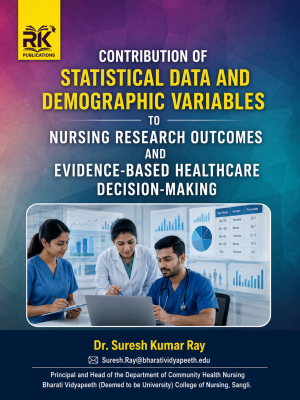
Contribution of Statistical Data and Demographic Variables to Nursing Research Outcomes and Evidence-Based Healthcare Decision-Making
Keywords:
Statistical Data | Demographic Variables | Nursing Research | Research Outcomes | Evidence-Based Practice (EBP) | Evidence-Based Healthcare | Healthcare Decision-Making | Nursing Practice | Clinical Decision-Making | Population Health | Epidemiology | Biostatistics | Data Analysis | Quantitative Research | Research Methodology | Health Informatics | Patient Outcomes | Healthcare Quality Improvement | Community Health Nursing | Nursing Education | Public Health | Clinical Research | Nursing Administration | Data-Driven HealthcareSynopsis
Statistical data and demographic variables play a vital role in nursing research by providing a scientific foundation for generating reliable evidence and improving healthcare decision-making. Statistical data enable researchers to collect, analyze, interpret, and validate research findings, while demographic variables such as age, gender, education, occupation, socioeconomic status, and geographic location help explain variations in health status, disease patterns, treatment responses, and healthcare utilization among different population groups. The integration of these elements enhances the accuracy, validity, and generalizability of research outcomes, enabling nurses and healthcare professionals to identify risk factors, evaluate interventions, and develop evidence-based clinical practices. Furthermore, statistical analysis and demographic profiling support healthcare planning, policy formulation, resource allocation, quality improvement, and patient-centered care by ensuring that healthcare decisions are based on objective evidence rather than assumptions. With the increasing adoption of health informatics and data-driven healthcare systems, the effective use of statistical data and demographic variables has become indispensable for advancing nursing science, improving patient outcomes, reducing health disparities, and strengthening evidence-based healthcare decision-making across clinical, educational, administrative, and public health settings.
Downloads
Download data is not yet available.
References
1. International Organization for Standardization. (2022). ISO/IEC 27001:2022 Information security, cybersecurity and privacy protection—Information security management systems—Requirements. ISO.
2. International Organization for Standardization. (2022). ISO/IEC 27002:2022 Information security, cybersecurity and privacy protection—Information security controls. ISO.
3. International Organization for Standardization. (2019). ISO/IEC 29115:2019 Information technology—Security techniques—Entity authentication assurance framework. ISO.
4. National Institute of Standards and Technology. (2020). Security and Privacy Controls for Information Systems and Organizations (Special Publication 800-53 Rev. 5). U.S. Department of Commerce.
5. National Institute of Standards and Technology. (2022). Digital Identity Guidelines (NIST SP 800-63 Revision 3). U.S. Department of Commerce.
6. World Wide Web Consortium. (2022). Verifiable Credentials Data Model 2.0. W3C Recommendation.
7. World Wide Web Consortium. (2021). Decentralized Identifiers (DIDs) v1.0. W3C Recommendation.
8. IMS Global Learning Consortium. (2023). Open Badges Specification Version 3.0. IMS Global.
9. Stallings, W. (2020). Cryptography and Network Security: Principles and Practice (8th ed.). Pearson.
10. Stallings, W. (2018). Effective Cybersecurity: A Guide to Using Best Practices and Standards. Addison-Wesley.
11. Schneier, B. (2015). Applied Cryptography: Protocols, Algorithms, and Source Code in C (20th Anniversary ed.). Wiley.
12. Menezes, A. J., van Oorschot, P. C., & Vanstone, S. A. (2018). Handbook of Applied Cryptography. CRC Press.
13. Kaufman, C., Perlman, R., & Speciner, M. (2021). Network Security: Private Communication in a Public World (3rd ed.). Pearson.
14. Bishop, M. (2019). Computer Security: Art and Science (2nd ed.). Addison-Wesley.
15. Easttom, C. (2022). Computer Security Fundamentals (5th ed.). Pearson.
16. Goodrich, M. T., Tamassia, R., & Goldwasser, M. H. (2020). Data Structures and Algorithms in Python. Wiley.
17. Sedgewick, R., & Wayne, K. (2011). Algorithms (4th ed.). Addison-Wesley.
18. Pressman, R. S., & Maxim, B. R. (2019). Software Engineering: A Practitioner's Approach (9th ed.). McGraw-Hill.
19. Sommerville, I. (2016). Software Engineering (10th ed.). Pearson.
20. Elmasri, R., & Navathe, S. B. (2017). Fundamentals of Database Systems (7th ed.). Pearson.
Downloads
Published
July 29, 2026
Copyright (c) 2026 RK PUBLICATION
Details about this monograph
ISBN-13 (15)
978-81-688864-8-3
How to Cite
Contribution of Statistical Data and Demographic Variables to Nursing Research Outcomes and Evidence-Based Healthcare Decision-Making. (2026). RK PUBLICATION. https://doi.org/10.66625/rkph.2026.0016