
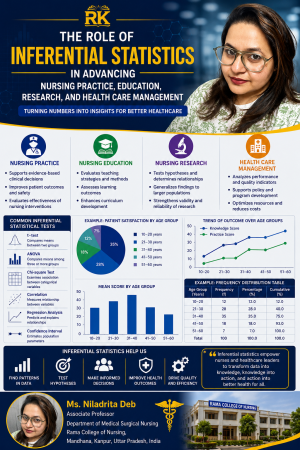
The Role of Inferential Statistics in Advancing Nursing Practice, Education, Research, and Health Care Management
Keywords:
Inferential Statistics, Nursing Research, Evidence-Based Practice, Nursing Practice, Nursing Education, Healthcare Management, Biostatistics, Statistical Analysis, Hypothesis Testing, Clinical Decision-Making, Data Analysis, Patient Outcomes, Quantitative Research, Nursing Informatics, Health Services Research.Synopsis
Abstract
Inferential statistics play a pivotal role in advancing nursing practice, education, research, and healthcare management by enabling evidence-based decision-making and the generalization of research findings from sample populations to broader clinical settings. Unlike descriptive statistics, inferential statistics provide methods for hypothesis testing, estimating population parameters, determining relationships among variables, and evaluating the effectiveness of healthcare interventions. In nursing practice, these statistical techniques support clinical decision-making, improve patient safety, and enhance the quality of care through the interpretation of research evidence. In nursing education, inferential statistics facilitate the evaluation of teaching strategies, curriculum effectiveness, student performance, and competency-based learning outcomes. Within nursing research, statistical methods such as t-tests, analysis of variance (ANOVA), chi-square tests, correlation, regression analysis, and confidence intervals strengthen the validity, reliability, and applicability of research findings. Furthermore, healthcare administrators utilize inferential statistics to assess organizational performance, optimize resource allocation, monitor quality indicators, and develop data-driven policies that improve healthcare delivery. The increasing integration of digital health technologies, electronic health records, and artificial intelligence has further expanded the application of inferential statistics in predictive analytics and healthcare innovation. This chapter reviews the fundamental concepts, major statistical techniques, practical applications, challenges, and future directions of inferential statistics across nursing and healthcare. It emphasizes that proficiency in inferential statistical methods is essential for nurses, educators, researchers, and healthcare managers to generate high-quality evidence, improve clinical outcomes, and support continuous quality improvement in modern healthcare systems.
Downloads
Download data is not yet available.
References
1. Burns, N., & Grove, S. K. (2021). Understanding nursing research: Building an evidence-based practice (8th ed.). Elsevier.
2. Polit, D. F., & Beck, C. T. (2021). Nursing research: Generating and assessing evidence for nursing practice (12th ed.). Wolters Kluwer.
3. Gray, J. R., Grove, S. K., & Sutherland, S. (2021). Burns and Grove's the practice of nursing research: Appraisal, synthesis, and generation of evidence (9th ed.). Elsevier.
4. Grove, S. K., Gray, J. R., & Burns, N. (2022). Statistics for health care research: A practical workbook (3rd ed.). Elsevier.
5. Field, A. (2022). Discovering statistics using IBM SPSS Statistics (6th ed.). Sage Publications.
6. Pallant, J. (2020). SPSS survival manual: A step-by-step guide to data analysis using IBM SPSS (7th ed.). McGraw-Hill Education.
7. Munro, B. H. (2020). Statistical methods for health care research (7th ed.). Wolters Kluwer.
8. Portney, L. G. (2020). Foundations of clinical research: Applications to evidence-based practice (4th ed.). F.A. Davis.
9. Melnyk, B. M., & Fineout-Overholt, E. (2023). Evidence-based practice in nursing and healthcare: A guide to best practice (5th ed.). Wolters Kluwer.
10. Hair, J. F., Black, W. C., Babin, B. J., & Anderson, R. E. (2022). Multivariate data analysis (9th ed.). Cengage Learning.
11. LoBiondo-Wood, G., & Haber, J. (2022). Nursing research: Methods and critical appraisal for evidence-based practice (10th ed.). Elsevier.
12. Schober, P., Boer, C., & Schwarte, L. A. (2018). Correlation coefficients: Appropriate use and interpretation. Anesthesia & Analgesia, 126(5), 1763–1768. https://doi.org/10.1213/ANE.0000000000002864
13. Sullivan, G. M., & Feinn, R. (2012). Using effect size—or why the P value is not enough. Journal of Graduate Medical Education, 4(3), 279–282. https://doi.org/10.4300/JGME-D-12-00156.1
14. Wasserstein, R. L., Schirm, A. L., & Lazar, N. A. (2019). Moving to a world beyond “p < 0.05.” The American Statistician, 73(Suppl. 1), 1–19. https://doi.org/10.1080/00031305.2019.1583913
15. World Health Organization. (2021). WHO guidance on research methods for health systems and evidence-based healthcare. World Health Organization.
Downloads
Published
July 12, 2026
Copyright (c) 2026 RK PUBLICATION
Details about this monograph
ISBN-13 (15)
978-81-687584-4-5
How to Cite
The Role of Inferential Statistics in Advancing Nursing Practice, Education, Research, and Health Care Management. (2026). RK PUBLICATION. https://doi.org/10.66625/rkph.2026.0014