
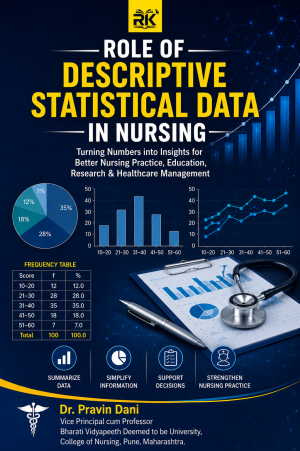
Role of Descriptive Statistical Data in Nursing Practice, Education, Research, and Healthcare Management
Keywords:
Descriptive Statistics, Nursing Practice, Nursing Education, Nursing Research, Healthcare Management, Data Analysis, Evidence-Based Practice, Quality Improvement, Clinical Decision-Making, Nursing Informatics.Synopsis
Descriptive statistical data play a fundamental role in nursing practice, education, research, and healthcare management by transforming raw data into meaningful information for informed decision-making. Descriptive statistics summarize and organize data using measures such as frequency, percentage, mean, median, mode, range, standard deviation, and graphical presentations. In nursing practice, these statistics help monitor patient outcomes, evaluate treatment effectiveness, identify health trends, and improve the quality and safety of patient care. In nursing education, descriptive statistical data are used to assess students' academic performance, evaluate teaching methods, identify learning needs, and support curriculum development. In nursing research, descriptive statistics provide a clear understanding of study variables, participant characteristics, and research findings, forming the foundation for further statistical analysis and evidence-based practice. In healthcare management, descriptive statistical data assist administrators in resource allocation, workforce planning, budgeting, quality assurance, infection surveillance, and policy development. The increasing use of electronic health records and health information systems has further enhanced the availability and application of descriptive statistical data in healthcare settings. Overall, descriptive statistical data serve as an essential tool for improving clinical decision-making, promoting evidence-based nursing, enhancing educational outcomes, supporting research, and strengthening healthcare management. Their effective use contributes to better patient care, efficient healthcare delivery, and continuous quality improvement across healthcare organizations.
Downloads
Download data is not yet available.
References
Polit, & Beck. (2021). Nursing research: Generating and assessing evidence for nursing practice (11th ed.). Wolters Kluwer.
Gray, Grove, & Sutherland. (2021). Burns and Grove's the practice of nursing research: Appraisal, synthesis, and generation of evidence (9th ed.). Elsevier.
Munro. (2005). Statistical methods for health care research (5th ed.). Lippincott Williams & Wilkins.
Daniel, & Cross. (2019). Biostatistics: A foundation for analysis in the health sciences (11th ed.). Wiley.
Gordis. (2014). Epidemiology (5th ed.). Elsevier.
World Health Organization. (2021). World health statistics 2021: Monitoring health for the SDGs. World Health Organization.
International Council of Nurses. (2021). The ICN code of ethics for nurses. International Council of Nurses.
American Nurses Association. (2021). Nursing: Scope and standards of practice (4th ed.). American Nurses Association.
Downloads
Published
July 7, 2026
Copyright (c) 2026 RK PUBLICATION
Details about this monograph
ISBN-13 (15)
978-81-687584-9-0
How to Cite
Role of Descriptive Statistical Data in Nursing Practice, Education, Research, and Healthcare Management. (2026). RK PUBLICATION. https://doi.org/10.66625/rkph.2026.0012