
This is an outdated version published on 2026-06-11. Read the most recent version.
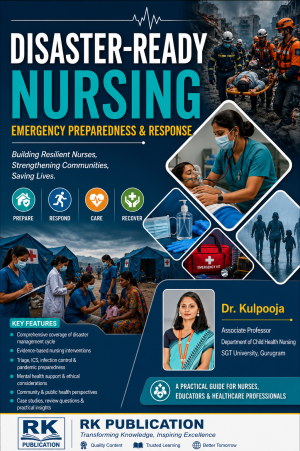
Disaster-Ready Nursing: Emergency Preparedness & Response
Keywords:
Disaster Nursing Emergency Preparedness Disaster Management Emergency Response Nursing Leadership Hospital Disaster Preparedness Community Preparedness Disaster Triage START Triage System Incident Command System (ICS) Mass Casualty Management Public Health Emergencies Pandemic Preparedness Infection Prevention and ControlSynopsis
Disasters, whether natural, biological, technological, or human-induced, pose significant challenges to healthcare systems and communities worldwide. The increasing frequency and complexity of emergencies have emphasized the need for disaster-ready healthcare professionals, particularly nurses, who constitute the largest segment of the healthcare workforce and play a pivotal role in disaster management. Disaster-Ready Nursing: Emergency Preparedness & Response provides a comprehensive overview of disaster nursing principles, emergency preparedness strategies, and evidence-based response mechanisms essential for effective healthcare delivery during crises. This book explores key concepts including disaster terminology, classification of disasters, disaster management cycle, mitigation, preparedness, emergency response, recovery and rehabilitation, hospital disaster preparedness, incident command systems, disaster triage, and the START triage model. It highlights the importance of community preparedness, public health response, infection prevention and control, psychological first aid, and pandemic preparedness in minimizing disaster-related morbidity and mortality. Special attention is given to vulnerable populations, ethical challenges, technological innovations, and the multifaceted role of nurses across all phases of disaster management.
Downloads
Download data is not yet available.
References
• American Nurses Association. (2021). Nursing: Scope and standards of practice (4th ed.). American Nurses Association.
• Federal Emergency Management Agency. (2022). National incident management system (3rd ed.). U.S. Department of Homeland Security.
• Haddow, G. D., Bullock, J. A., & Coppola, D. P. (2021). Introduction to emergency management (7th ed.). Butterworth-Heinemann.
• International Council of Nurses. (2019). Core competencies in disaster nursing version 2.0. International Council of Nurses.
• International Federation of Red Cross and Red Crescent Societies. (2023). World disasters report 2023: Resilience in action. IFRC.
• Kapucu, N., & Ozerdem, A. (2019). Managing emergencies and crises. Jones & Bartlett Learning.
• Park, K. (2023). Park's textbook of preventive and social medicine (27th ed.). Banarsidas Bhanot Publishers.
• Polit, D. F., & Beck, C. T. (2021). Nursing research: Generating and assessing evidence for nursing practice (11th ed.). Wolters Kluwer.
• Potter, P. A., Perry, A. G., Stockert, P. A., & Hall, A. M. (2023). Fundamentals of nursing (11th ed.). Elsevier.
• Stanhope, M., & Lancaster, J. (2022). Public health nursing: Population-centered health care in the community (11th ed.). Elsevier.
• United Nations Office for Disaster Risk Reduction. (2023). Sendai framework for disaster risk reduction 2015–2030. United Nations. https://www.undrr.org
• Veenema, T. G. (Ed.). (2019). Disaster nursing and emergency preparedness for chemical, biological, and radiological terrorism and other hazards (4th ed.). Springer Publishing Company.
• World Health Organization. (2021). Health emergency and disaster risk management framework. World Health Organization.
• World Health Organization. (2023). Emergency preparedness, response and resilience. World Health Organization.
• World Health Organization. (2024). Global strategic preparedness and response plan. World Health Organization.
• American Nurses Association. (2021). Nursing: Scope and standards of practice (4th ed.). American Nurses Association.
• Federal Emergency Management Agency. (2022). National incident management system (3rd ed.). U.S. Department of Homeland Security.
• Haddow, G. D., Bullock, J. A., & Coppola, D. P. (2021). Introduction to emergency management (7th ed.). Butterworth-Heinemann.
• International Council of Nurses. (2019). Core competencies in disaster nursing version 2.0. International Council of Nurses.
• International Federation of Red Cross and Red Crescent Societies. (2023). World disasters report 2023: Resilience in action. IFRC.
• Kapucu, N., & Ozerdem, A. (2019). Managing emergencies and crises. Jones & Bartlett Learning.
• Park, K. (2023). Park's textbook of preventive and social medicine (27th ed.). Banarsidas Bhanot Publishers.
• Polit, D. F., & Beck, C. T. (2021). Nursing research: Generating and assessing evidence for nursing practice (11th ed.). Wolters Kluwer.
• Potter, P. A., Perry, A. G., Stockert, P. A., & Hall, A. M. (2023). Fundamentals of nursing (11th ed.). Elsevier.
• Stanhope, M., & Lancaster, J. (2022). Public health nursing: Population-centered health care in the community (11th ed.). Elsevier.
• United Nations Office for Disaster Risk Reduction. (2023). Sendai framework for disaster risk reduction 2015–2030. United Nations. https://www.undrr.org
• Veenema, T. G. (Ed.). (2019). Disaster nursing and emergency preparedness for chemical, biological, and radiological terrorism and other hazards (4th ed.). Springer Publishing Company.
• World Health Organization. (2021). Health emergency and disaster risk management framework. World Health Organization.
• World Health Organization. (2023). Emergency preparedness, response and resilience. World Health Organization.
• World Health Organization. (2024). Global strategic preparedness and response plan. World Health Organization.
Published
June 11, 2026
Versions
- 2026-06-11 (2)
- 2026-06-11 (1)
Copyright (c) 2026 RK PUBLICATION
How to Cite
Disaster-Ready Nursing: Emergency Preparedness & Response. (2026). RK PUBLICATION. https://doi.org/10.66625/rkph.2026.005