
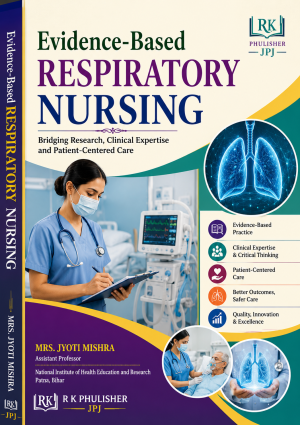
Evidence-Based Respiratory Nursing
Keywords:
Evidence-Based Practice; Respiratory Nursing; Respiratory Care; Oxygen Therapy; Pulmonary Rehabilitation; Airway Management; Mechanical Ventilation; Chronic Obstructive Pulmonary Disease; Asthma; Pneumonia; Tuberculosis; Patient Safety; Clinical-Making; Nursing Research; Healthcare Quality; Telehealth; Artificial Intelligence in Healthcare; Respiratory Assessment; Evidence-Based Interventions; Nursing Education.Synopsis
Respiratory diseases constitute a major public health challenge globally and are responsible for substantial morbidity, mortality, and healthcare expenditure. The increasing prevalence of conditions such as chronic obstructive pulmonary disease (COPD), asthma, pneumonia, tuberculosis, pulmonary fibrosis, and acute respiratory distress syndrome has highlighted the need for effective, safe, and evidence-based nursing interventions. Evidence-Based Respiratory Nursing is an approach that integrates the best available scientific evidence, clinical expertise, and patient preferences to guide respiratory care decisions. This approach ensures that nursing interventions are supported by current research findings and are tailored to the unique needs of individual patients.
The application of evidence-based principles in respiratory nursing enhances the quality of patient care, improves clinical outcomes, reduces healthcare-associated complications, and promotes patient safety. Nurses play a central role in respiratory assessment, oxygen therapy management, airway maintenance, pulmonary rehabilitation, patient education, infection prevention, and long-term disease management. By utilizing evidence-based interventions, respiratory nurses can optimize respiratory function, prevent disease progression, and improve the overall quality of life of patients with respiratory disorders.
Advancements in healthcare technology, including artificial intelligence, telehealth, wearable monitoring devices, and electronic health records, have further expanded the scope of evidence-based respiratory nursing. These innovations support clinical decision-making, facilitate early detection of respiratory deterioration, and enhance continuity of care across healthcare settings. Despite these advancements, challenges such as limited access to research resources, inadequate training, resistance to change, and organizational barriers may hinder the implementation of evidence-based practice.
Evidence-Based Respiratory Nursing emphasizes continuous professional development, critical thinking, interdisciplinary collaboration, and patient-centered care. As healthcare systems continue to evolve, respiratory nurses must remain committed to integrating scientific evidence into clinical practice to ensure high-quality, safe, and effective patient care. The future of respiratory nursing depends on the successful adoption of evidence-based approaches that support innovation, quality improvement, and excellence in healthcare delivery.
Downloads
Download data is not yet available.
References
1. Melnyk, B. M., & Fineout-Overholt, E. (2023). Evidence-Based Practice in Nursing and Healthcare: A Guide to Best Practice (5th ed.). Wolters Kluwer.
2. Hinkle, J. L., & Cheever, K. H. (2022). Brunner & Suddarth's Textbook of Medical-Surgical Nursing (15th ed.). Wolters Kluwer.
3. Lewis, S. L., Bucher, L., Heitkemper, M. M., Harding, M. M., Kwong, J., & Roberts, D. (2023). Medical-Surgical Nursing: Assessment and Management of Clinical Problems (12th ed.). Elsevier.
4. Black, J. M., & Hawks, J. H. (2021). Medical-Surgical Nursing: Clinical Management for Positive Outcomes (11th ed.). Elsevier.
5. World Health Organization. (2023). Global Surveillance, Prevention and Control of Chronic Respiratory Diseases. Geneva: WHO.
6. Global Initiative for Chronic Obstructive Lung Disease (GOLD). (2024). Global Strategy for Prevention, Diagnosis and Management of COPD.
7. Global Initiative for Asthma (GINA). (2024). Global Strategy for Asthma Management and Prevention.
8. American Association of Critical-Care Nurses (AACN). (2023). AACN Procedure Manual for High Acuity, Progressive and Critical Care.
9. Urden, L. D., Stacy, K. M., & Lough, M. E. (2022). Critical Care Nursing: Diagnosis and Management (10th ed.). Elsevier.
10. Ignatavicius, D. D., Workman, M. L., Rebar, C. R., & Heimgartner, N. M. (2024). Medical-Surgical Nursing: Concepts for Interprofessional Collaborative Care (11th ed.). Elsevier.
11. Polit, D. F., & Beck, C. T. (2021). Nursing Research: Generating and Assessing Evidence for Nursing Practice (11th ed.). Wolters Kluwer.
12. Grove, S. K., Gray, J. R., & Burns, N. (2022). Understanding Nursing Research: Building an Evidence-Based Practice (8th ed.). Elsevier.
13. Smeltzer, S. C., Bare, B. G., Hinkle, J. L., & Cheever, K. H. (2022). Textbook of Medical-Surgical Nursing. Wolters Kluwer.
14. World Health Organization. (2024). Tuberculosis and Respiratory Disease Management Guidelines. Geneva: WHO.
15. International Council of Nurses. (2024). Nursing and Digital Health: Future Directions for Clinical Practice. Geneva: ICN.
Downloads
Published
June 1, 2026
Copyright (c) 2026 RK PUBLICATION
How to Cite
Evidence-Based Respiratory Nursing. (2026). RK PUBLICATION. https://doi.org/10.66625/rkph.2026.003