
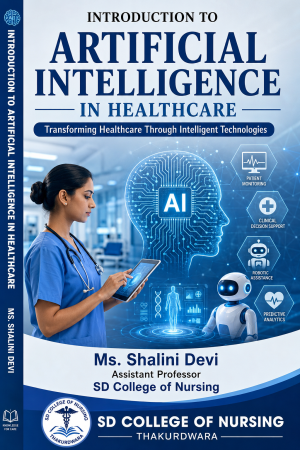
Introduction to Artificial Intelligence in Healthcare
Keywords:
Artificial Intelligence (AI); Healthcare Technology; Nursing Informatics; Machine Learning; Deep Learning; Natural Language Processing; Clinical Decision Support Systems; Predictive Analytics; Digital Health; Smart Healthcare; Patient Safety; Healthcare Innovation; Nursing Practice; Healthcare Management; Robotics in Healthcare.Synopsis
Artificial Intelligence (AI) has emerged as a transformative technology that is revolutionizing healthcare delivery worldwide. By enabling machines and computer systems to perform tasks that traditionally require human intelligence, AI has significantly enhanced clinical decision-making, disease diagnosis, patient monitoring, healthcare management, and nursing practice. The integration of AI technologies such as machine learning, deep learning, natural language processing, predictive analytics, and robotics has improved the accuracy, efficiency, and quality of healthcare services. In nursing, AI supports evidence-based practice, reduces administrative burden, enhances patient safety, and facilitates personalized patient care. Healthcare organizations are increasingly adopting AI-powered systems to address challenges related to workforce shortages, rising healthcare costs, and growing patient demands. Despite its numerous benefits, AI implementation presents ethical, legal, technical, and educational challenges that require careful consideration. Understanding the principles, applications, opportunities, and limitations of Artificial Intelligence is essential for healthcare professionals to effectively utilize emerging technologies and contribute to the future of digital healthcare. This chapter provides a comprehensive introduction to Artificial Intelligence in healthcare, highlighting its evolution, core concepts, applications, benefits, challenges, and future implications for nursing and healthcare practice.
Downloads
Download data is not yet available.
References
References
1. Russell, S., & Norvig, P. (2021). Artificial Intelligence: A Modern Approach (4th ed.). Pearson Education.
2. Topol, E. (2019). Deep Medicine: How Artificial Intelligence Can Make Healthcare Human Again. Basic Books.
3. Jiang, F., Jiang, Y., Zhi, H., Dong, Y., Li, H., Ma, S., Wang, Y., Dong, Q., Shen, H., & Wang, Y. (2017). Artificial Intelligence in healthcare: Past, present and future. Stroke and Vascular Neurology, 2(4), 230–243.
4. World Health Organization (WHO). (2021). Ethics and Governance of Artificial Intelligence for Health. Geneva: WHO.
5. International Council of Nurses (ICN). (2024). Nursing and Digital Health Technologies. Geneva: ICN.
6. Kaplan, A., & Haenlein, M. (2019). Siri, Siri, in my hand: Who's the fairest in the land? On the interpretations, illustrations, and implications of Artificial Intelligence. Business Horizons, 62(1), 15–25.
7. Davenport, T., & Kalakota, R. (2019). The potential for Artificial Intelligence in healthcare. Future Healthcare Journal, 6(2), 94–98.
8. McCarthy, J. (2007). What is Artificial Intelligence? Stanford University, Department of Computer Science.
9. Reddy, S. (2020). Artificial Intelligence in healthcare: Opportunities and challenges. British Journal of Healthcare Management, 26(5), 1–7.
10. Booth, R. G., Strudwick, G., McBride, S., O'Connor, S., & Solano López, A. L. (2021). How the nursing profession should adapt for a digital future. BMJ, 373, n1190.
Downloads
Published
June 1, 2026
Copyright (c) 2026 RK PUBLICATION
Details about this monograph
ISBN-13 (15)
978-81-685670-7-8
How to Cite
Introduction to Artificial Intelligence in Healthcare. (2026). RK PUBLICATION. https://doi.org/10.66625/rkph.2026.006